
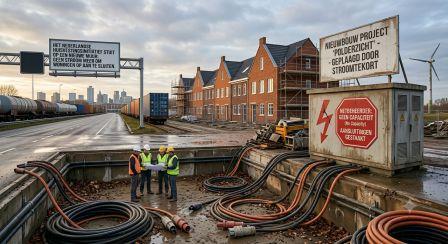
The Netherlands has spent years trying to solve one crisis — a housing shortage that leaves hundreds of thousands of people searching for a home — only to run headfirst into another. This time, the obstacle isn’t permits, nitrogen rules, or construction costs. It’s electricity.
According to Netbeheer Nederland, the umbrella body for the country’s grid operators, developers have filed connection requests for roughly 600,000 homes due to be built over the next three years. That figure is more than double the Netherlands’ usual three-year building pace of around 285,000 homes, and it’s the highest number of applications the sector has ever recorded in a single half-year stretch. The problem: the grid simply doesn’t have room for all of them. Grid operators say there is no available capacity for nearly half of the roughly 600,000 homes for which power connections have been requested. Dutchbrief
Why this is happening now
Part of the surge is self-inflicted timing. New regulations that took effect on 1 July prompted developers to file a flood of connection requests for homes that haven’t even been built yet, so they wouldn’t be stuck on a waiting list later. But the underlying issue predates the rule change. The Dutch grid has been congested for years, squeezed by electric vehicles, heat pumps, solar panels, and data centres all competing for the same limited capacity on ageing infrastructure that was never built for this level of demand.
Netbeheer Nederland is trying to strike a reassuring tone, noting that a rejected application today isn’t necessarily a rejection forever — capacity can open up as grids expand or project timelines shift. But for the housing sector, “eventually” isn’t good enough.
Housing groups are sounding the alarm
Aedes, the federation representing Dutch housing associations, put it bluntly: associations are pouring money into projects today that won’t produce a single finished home for years, and even projects that are already under construction and fully funded have no guarantee of a grid connection. If that certainty doesn’t materialise, Aedes warns, the result is longer delays, higher costs, and longer waits for people trying to find an affordable place to live.
Homeowners aren’t insulated from the fallout either. Vereniging Eigen Huis, the Dutch homeowners’ association, says buyers are increasingly left in limbo — sometimes having already given notice on a rental or sold their previous home, only to face storage costs and temporary housing while they wait for their new place to actually get power. Many contracts allow for compensation when delivery slips past the agreed construction period, but that doesn’t make the uncertainty any less stressful.
A problem concentrated in a few provinces — for now
The crunch is worst in Utrecht, Gelderland, and Flevoland, where grid operator TenneT has warned that high-voltage capacity is essentially maxed out. Regional operators such as Alliander, Enexis, and Stedin have already placed thousands of households on waiting lists for upgraded connections, some facing waits of up to three years. Attempts to expand the grid faster are running into a separate obstacle: a sharp rise in legal objections and appeals from residents and landowners near proposed new lines and substations, which typically adds an extra two years to already lengthy projects.
What it means for the government’s housing targets
The Netherlands is aiming to add close to 100,000 new homes in 2027, part of a broader national commitment to build nearly a million homes by 2030. That target was already under pressure from nitrogen-emission restrictions limiting construction near protected nature areas. Now grid capacity has become the second major bottleneck squeezing the same pipeline of projects — and provincial authorities have previously warned that as much as half of the remaining housing target, roughly 500,000 homes, could face serious delays or fail to materialise altogether.
For house-hunters, the practical upshot is straightforward, if unwelcome: a home being built doesn’t necessarily mean a home you can move into on schedule. Both Aedes and Vereniging Eigen Huis are pushing for the government and grid operators to give clearer, earlier answers on which projects will get connected and when — arguing that uncertainty itself, as much as the shortage, is now doing damage.
Sources
- NL Times — Overloaded Dutch power grid delays new homes, raising costs and wait times
- NL Times — Grid congestion: No space on power grid for nearly half of newly built homes
- NL Times — Local objections delay Dutch power grid expansion amid severe congestion
What do you feel about this post?

Like

Love

Happy

Haha

Sad